Simulating Real-World Warehousing: A Full-Stack Inventory & Order Fulfillment Platform
Started December 2025 - Ended April 2026
Node.js
Express.js
React.js
Redux
TypeScript
PostgreSQL
Tailwind CSS
Docker
GitHub
Git
Docker
Swagger / OpenAPI
Netlify
Visual Studio Code
A full-stack Warehouse Management System built to simulate the operational complexity of real-world inventory and order fulfillment workflows. Featuring a ledger-based inventory engine, bucket-based location structure, role-based access control, and CI/CD automation via GitHub Actions.
Introduction
The Warehouse Management System is a full-stack web application built to simulate the operational complexity of real-world inventory and order fulfillment workflows. At first glance, a WMS appears simple — products come in, orders go out. But under the hood, the workflow is significantly more complex: products must be imported, placed into specific warehouse locations, tracked during every movement, and eventually allocated and fulfilled — all while maintaining an accurate, real-time inventory state.
Objectives and Scope
This project was created after researching various enterprise systems to tackle that complexity head-on. The goal was to build a simplified yet structurally sound version of a WMS, while deepening my backend development skills in Node.js — coming from a background in Laravel, React, Vue, and TypeScript. The scope included a full inventory lifecycle pipeline, role-based access control, automated CI/CD via GitHub Actions, and comprehensive API documentation through Swagger / OpenAPI.
Architecture Highlights
One of the core design challenges was building a reliable way to track every inventory movement while maintaining an accurate current state. Inspired by financial transaction systems used in fintech, each inventory movement is recorded as an immutable transaction entry rather than directly mutating the current state — ensuring full traceability, consistency, and auditability. Warehouse storage is modeled using a bucket-based location system, allowing products to be organized within specific, named storage locations across the warehouse floor. The full inventory lifecycle covers: Product Import → Stock Placement → Inventory Transfer → Order Allocation → Order Fulfillment.
Technology Stack
The backend was built with Node.js and Express.js, using TypeScript for type safety throughout the codebase. PostgreSQL — hosted on Supabase — serves as the relational database, managed via TypeORM. Incoming data is validated using Zod schemas. The frontend was built with React.js, Redux Toolkit, and Tailwind CSS, bundled with Vite for a fast development workflow. The entire application is containerized with Docker and deployed via automated pipelines on GitHub Actions.
Skills Demonstrated
This project significantly deepened my expertise in Backend Architecture with Node.js, particularly around designing a ledger-based inventory engine and a structured RESTful API. I applied Role-Based Access Control to separate system responsibilities across four distinct user roles. The project also provided hands-on experience with CI/CD Automation using GitHub Actions, Docker containerization, and API documentation best practices with Swagger.
Conclusion
The Warehouse Management System successfully demonstrates how a complex operational domain can be translated into a clean, maintainable, and scalable full-stack application. The project reflects a deliberate focus on system design quality — from immutable inventory ledgers to automated deployment pipelines — and stands as a strong demonstration of production-minded backend development.
Gallery
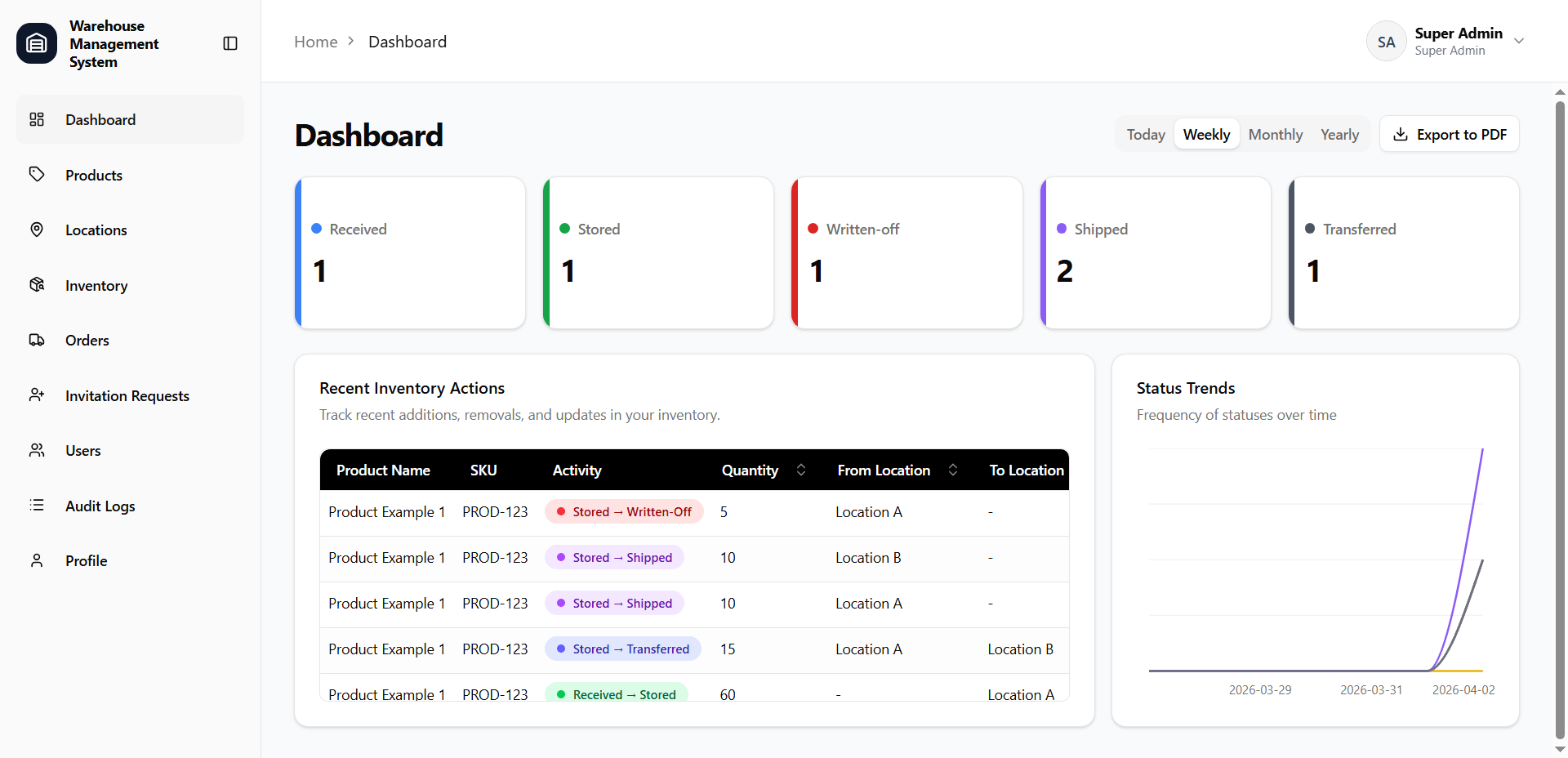
The main dashboard providing a visual overview of warehouse health, stock levels, and order fulfillment rates.
 Node.js
 Express.js
 React.js
 Redux
Redux TypeScript
 PostgreSQL
 Tailwind CSS
 Docker
 GitHub
 Git
Git Swagger / OpenAPI
 Netlify
 Visual Studio Code